Between Sundays


Dear UUCV Members and Friends,

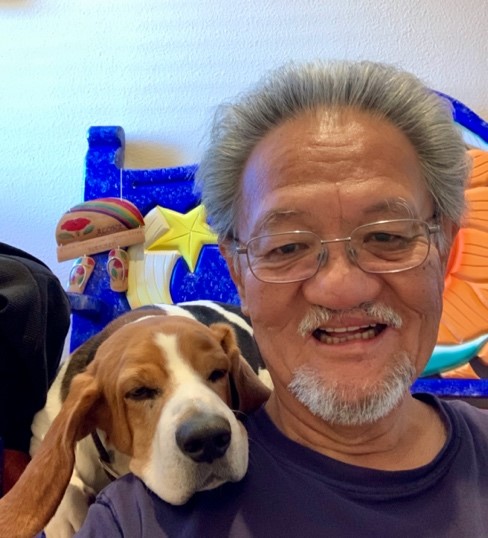
    As your Board President who is of Japanese ancestry, I have felt increasingly compelled to speak out against the increasing, horrific racism and violence against Asian Americans and Pacific Islanders (AAPI).  A recent media account reported nearly 3800 incidents across the country since the beginning of the pandemic.  And this is considered to be a fraction of the true total.
 
Of course, violence and discrimination towards AAPI people are not new phenomena.  From the infamous massacre of Chinese Americans in Los Angeles in 1871 to the Chinese Exclusion Act of 1882 to laws prohibiting land ownership by Asians in the 1920’s to the relocation of Japanese Americans during World War II, legal sanctions as well as overt racist violence towards AAPI communities have a long history.  My parents and three older siblings were part of the relocation of Japanese Americans during World War II.  They were sent to the infamous Tule Lake relocation center and later to Amache, Colorado. 
 
Prior to World War II, my three siblings were born in the Japanese Hospital of Los Angeles, a hospital that was founded because Japanese immigrants were not allowed to use white hospitals.  As a result of the relocation, my parents lost the grocery store and five & dime store they operated in LA’s little Tokyo.  I can only imagine the overt racism members of my family experienced. 
 
My mother was the oldest of nine children.  Seven of her siblings also went to relocation camps.  One sibling, an uncle I never met, died when the Hiroshima bomb fell.  The other sibling, my aunt Alice, survived the atomic bomb but lost her husband and young daughter.  Remarkably, Alice just turned 100.  By the way, all nine children in my mother’s family were American citizens.  Two of my uncles volunteered to serve in the U.S. Army after being released from camp.
 
I was born shortly after World War II ended and did not experience the same level of overt racism.  I grew up in Denver, Colorado, the nearest large city after my parents were released from the Amache relocation camp.  I certainly recall racial taunts directed at me from time to time.  Being called a “chink” and a “Jap” were probably the most common.  The 1950’s were not that far removed from World War II and there were still hard feelings about the war, even though the great majority of Japanese Americans were American citizens.

My family moved back to California when I was age 12.  We lived in Gardena, at the time the mainland city with the highest percentage of Japanese Americans outside of Hawaii.  Racial tensions were a fact of life.  The Gardena Buddhist Church I attended was set on fire in two arson incidents.  When the Vietnam War broke out in the 1960’s, Asian Americans again became easily identified targets for hostility.  I still remember a high school friend who was drafted talk about being singled out by his platoon leader, who proclaimed to gathered American soldiers:  “This is what a Gook looks like.”
 
AAPI people occupy a peculiar place among peoples of color.  On the one hand, we are sometimes under the radar or even held up as “model minorities.”  Japanese Americans, especially, have often been cited for being successful academically and assimilating well into the dominant culture.  Certainly, there are wealthy and successful Asian Americans.  But AAPI peoples represent diverse, multicultural histories and traditions.  There are plenty of poor, struggling AAPI who live in poverty and are struggling to survive. 
 
AAPI people can also become highly visible, especially during times of economic or political stress.  It becomes convenient to blame AAPI folks for the “Kungflu” or “China virus.”  The late Vincent Chin was murdered in Detroit in 1982 because two white men thought he was Japanese and should be blamed for the decline of American automakers.  Asian Americans were targeted after the outbreak of the Korean and Vietnam Wars as well as World War II.
 
As an adult, I have often experienced interactions that tell me I am seen as different.  Perhaps the most common one is “where are you from?”  I know I am not being asked if I am from Denver, Gardena, Los Angeles, Santa Clarita, or Oxnard, all places I have lived.  I am sorry that I have to explain I am not a math wizard, am not crazy about sushi, like VWs more than Toyotas, and am not fluent in Japanese.  Stereotypes sometimes worked in my favor.  I recall that bullies in elementary school thought I knew karate so left me alone.
 
Madelaine and I moved to Oxnard in 2015, attracted in part because of Oxnard’s diversity.  Japanese Americans have a long history in the city.  They famously worked the strawberry fields in the area.  Two of Oxnard’s mayors were of Japanese ancestry.  The Oxnard Buddhist Church was founded in 1929.
 
I am especially proud that the Oxnard City Council recently passed a resolution condemning racism, xenophobia, violence, and hate crimes against Asian Americans and Pacific Islanders.  The resolution was initiated by white and Latino council members. I have noted that many key members of Oxnard city government, from citizen advisory groups to the Mayor to the City Council to the City Manager and city staff are people of color.  It is a great thing that city governance reflects the diversity of the community.
 
I am also happy that the UUA recently acknowledged the surge in hate crimes against Asians and Asian Americans.  It called upon federal, state, and local governments to send a clear message that anti-Asian violence and harassment will not be tolerated.  The UUA recognized that anti-AAPI racism is rooted in the same white supremacy that targets all BIPOC people.  White supremacy culture is so deeply rooted in our country’s history that it remains one of the great challenges of our time.  It is the source of systemic racism that seeks to marginalize all people who are seen as different. 
 
I especially appreciate the UU principles that affirm the inherent worth and dignity of every person, and that we should seek justice, equity, and compassion in human relations.  It is with interest that I note a recent movement towards forming AAPI caucuses within UUA regions and the Diverse Revolutionary Unitarian Universalist Multicultural Ministries (DRUMM). 
 
I am hopeful that UUCV will continue to promote a healthy examination of race relations, both internally and beyond church boundaries.  Programs such as Beloved ConversationsWitnessing Whiteness, and the formation of a cluster-wide BIPOC Caucus offer opportunities to promote multiculturalism and better race relations.  I encourage all of us to take advantage of these kinds of opportunities.  Understanding our own attitudes about race and working towards racial equality are long-term challenges that require patience and a commitment to intentional change.
 
 
Be well,
Yukio Okano
UUCV Board President
Between Sundays April, 2021

Dear Members and Friends,

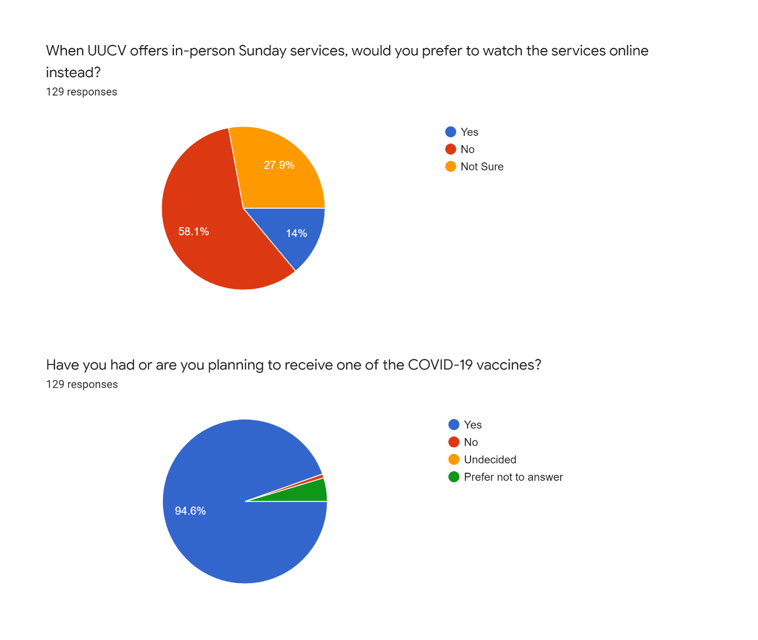
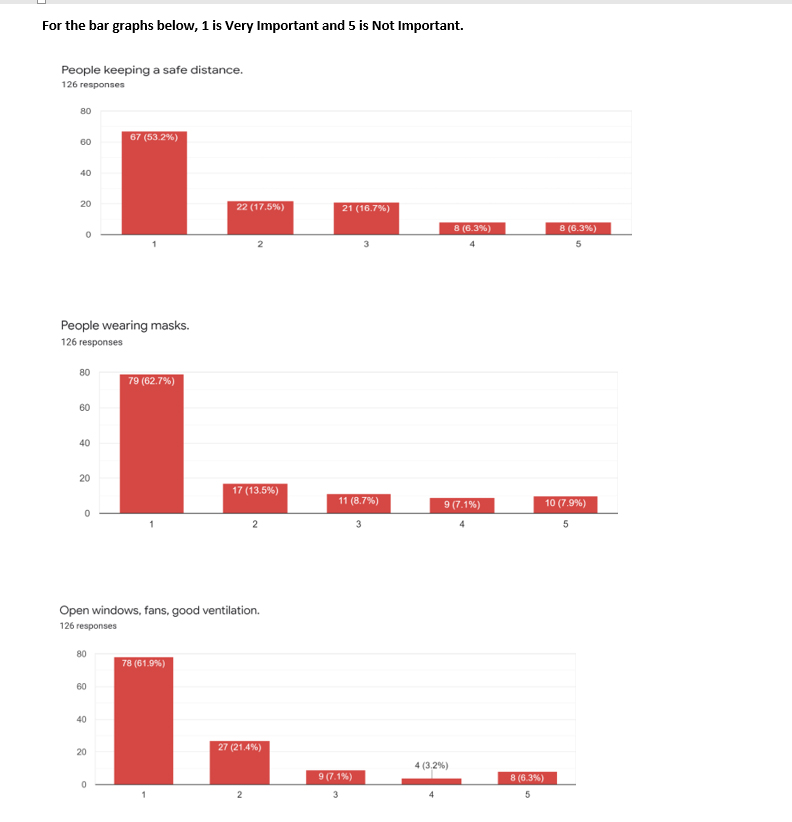
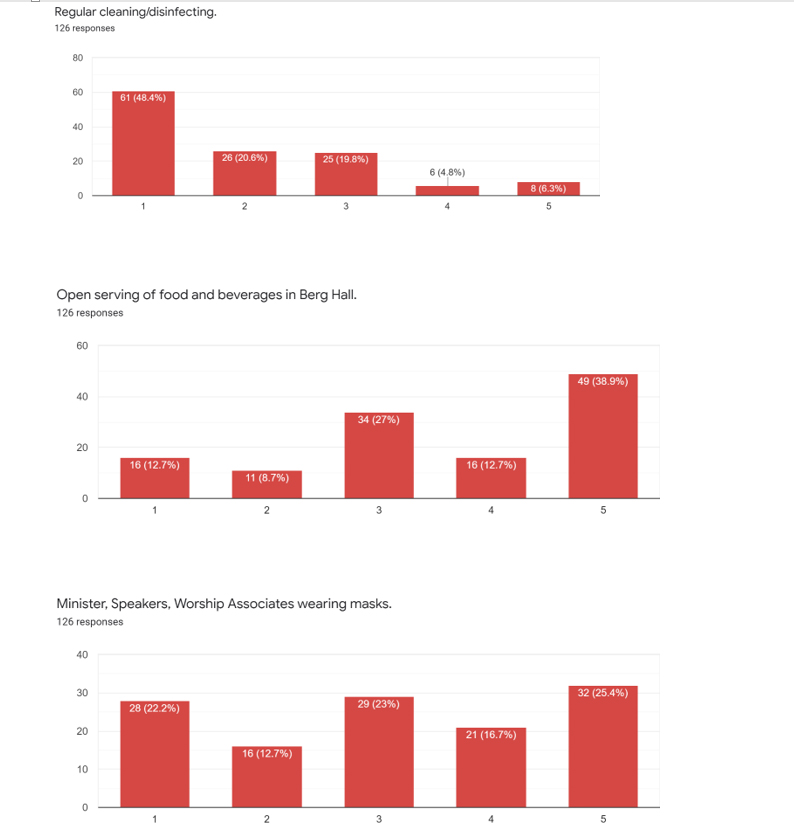
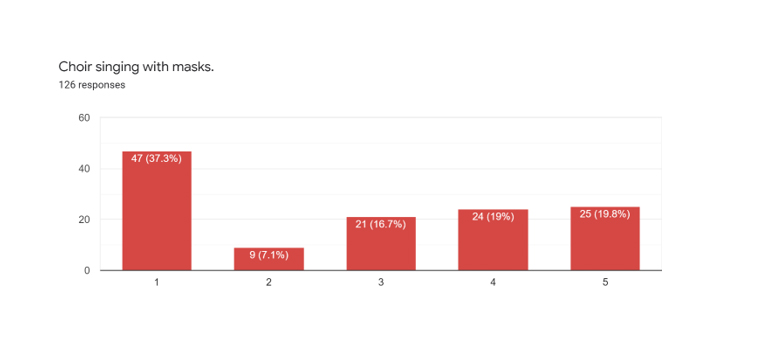
Recently, many of you participated in a survey from the Re-Opening Team intended to obtain your input about the re-opening of our church facility.  The following is a summary of those responses.  Part of the survey had questions that allowed for the responses to be illustrated in the graphs below.  Other questions presented the opportunity for you to comment directly.  Responses have been edited into several categories/themes and are presented after the graphs.  The information that this survey provides will be used to help guide the Re-Opening Team in making recommendations to the Board of Trustees.  Thank you for your help.

The Re-Opening Team
Priscilla Akin, Kent Brinkmeyer, Bryan Buck, Melissa Ruiz, Cassie Tondro, Jim Waldron

What would make you feel comfortable to attend in-person indoor services?

Social distancing, reduced capacity in sanctuary      43

Everyone vaccinated                                                  30

Mandatory masks                                                       29

High percentage vaccinated                                      13

Good ventilation, windows open                                  8

Lower infection rate                                                      6

Follow CDC/California guidelines                                6

Not comfortable being inside yet                                 6

Temperature checks                                                    5

No hugging/touching                                                    4

Comfortable now as is                                                 4

No singing                                                                    3

Hand sanitizer stations                                                 3

No food                                                                         3

Outdoor coffee hour                                                     2

Thorough cleaning of building                                      2

Outdoor services                                                          1

No hymnals                                                                  1

No masks, get back to normal                                     1

If you have children, what will make you feel comfortable to bring your children to in-person RE classes?

Staff vaccinated                                                           7

Mandatory masks                                                         4

Outdoor classes                                                           4

Social distancing                                                          2

No masks, get back to normal                                     2

Clear plan for safety protocols                                     2

Temperature checks                                                    1

Hand sanitizer stations                                                 1

Not comfortable yet                                                      1

Do you have any other thoughts or suggestions about how we can safely reopen the church and about what would make you feel comfortable doing so?

Speakers at the podium don’t need to wear masks, but anyone in the congregation area should be masked.

Keep surfaces clean, but don’t get obsessive about it. Unnecessary and possibly detrimental to our immune systems.

Put faith above fear.

Monitor in Berg Hall for the overflow crowd to watch services.

Take it slow and easy and incrementally allow more people in.

Continue with online services for those who aren’t comfortable attending in person, those who live far away, and those who are homebound.

Services outdoors, weather permitting.

Servers for the food at coffee hour rather than everyone hovering over the food. People wait in line for food.

Rotate attendance so that some people are allowed to attend one week, and another group the next week.

Use a reservation system for those who would like to attend in-person services and limit the number.

Ask those not vaccinated to attend the Zoom services instead of in-person services.

Bring our own snacks/food.

Poll people and publish/share the percentage who have been vaccinated.

Only socialize with people who have been vaccinated.

Before anyone can honestly answer these questions, one would have to know the approximate date of planned opening.

Plexiglas shield around the minister’s podium.

Don’t pass the collection bags.

Message on our name tags saying something like “social distance please” as a reminder.

No hugging, kissing children, hands on shoulders, or holding hands. “No contact” policy.

No hymnals. Words to the songs on the monitors.

I am comfortable now. I’m vaccinated so anything is okay.

Between Sundays Apr 22, 2021

Good People,  
Folks keep asking if we have a date set for reopening for worshiping in person. The answer is, Kind of….

Here is the Big Picture background and tentative plans.
Our Reopening Team has been looking closely at the details of how and when we will reopen.
They sent out the recent survey, which 128 people responded to. Thank you!
And, of course the Board of Trustees is staying abreast of it all.

I have also been in regular contact with the other clergy in our cluster. We have all agreed that if at all possible, all six cluster congregations will open for in-person worship on the same Sunday. We tentatively, and perhaps optimistically, are hoping that Sunday will be Sept. 12. That is the date we would all be holding our various In-Gathering and Water Communion Services, which would feel so good.

By that date we are hopeful that everyone who wants one will have gotten a vaccination. By that date we will likely have had time to install and practice with a camera and video system that will allow us to continue to Zoom and/or stream our services to all who still want or need to join worship from home.

The Reopening Team and the Board concur with this overall concept and timeline. Yet this is still tentative. September is almost five months from now, and any number of different things may yet happen.

So, keep fingers crossed, think positive thoughts, send out prayers and good vibrations – whatever works for you. My good colleague Rev. Rod Richards from San Luis Obispo says he has been preaching on Holy Flexibility this whole year. So, let us also practice Holy Flexibility for these next months,

And in the Mean Time…We can start gradually, not turning the spigot from ‘off’ to ‘full strength’ overnight. Here are planned small steps and some suggestions for easing in gradually.

The Board has approved the Reopening Team’s recommendation that we can reopen – just for small groups in Berg Hall on May 1. The church will be deep, deep cleaned by April 30. Look for more details about guidelines and protocols for those small groups soon. They will include people being masked and distanced with doors and windows open. Everyone will need to schedule meetings with Administrator Jennifer Luce.

This can help us all see a few people, and then a few people more. So, we can practice ‘people-ing’ again gradually. Personally, I have found my ‘people-ing’  muscles are out of shape.

A couple weeks back, Jimmy led a Yarn-Bombing event in celebration of our newest members. I was so happy to see those 15 folks, that I found myself talking and laughing, spinning in metaphorical and literal circles. I was exhausted by 1 pm that Saturday, and I had to go home and take a nap before finishing the service for the next day.

Our Reopening Team, our Board, and our cluster congregations are moving thoughtfully and carefully toward reopening. We want everyone to be as safe as possible, especially those who are most vulnerable among us. There are so many factors to consider. And we can begin practicing being together again in this new world.

We will not go back to what we once called ‘normal.’ We’ll be finding our way again newly. Look to this Between Sundays space for more detailed information in the coming weeks from the Board and the Reopening Team.

With love and hope,
Rev. Dana

Between Sundays April, 2021

Good People,

Writing to let you know that I have been selected as a member of the General Plan Advisory Committee for the City of Ventura. I applied because giving input into the cities General Plan means I can address a confluence of issues that are of great importance to me and to the times we are living in and through.

The advisory committee is gathered to provide insights to the General Plan project team to better understand sensitive community needs and also to encourage people to engage with the general plan process. It is an advisory body that does get to make recommendations to the City Council as they update the General Plan.

I wanted to be part of the committee because it is a place that so many of my own and our congregation’s justice concerns intersect. I hope that I can advocate for services for our homeless neighbors and for truly affordable housing for people of all income levels. I hope that the plan can begin to address the continuing effects of age-old and recent ‘red-lining’ housing practices.

This General Plan looks 10 years ahead, and I am highly aware that this is a critical decade for us all to address the effects of climate change that will continue to unfold for the next 20, 30, 40 years and more. Transforming our city into a place that is environmentally sustainable community will mean reducing cars, increasing walkability, increasing bike-ability, and creating efficient and useful public transportation,

I see this work also as an intersection of own sense of urgency as a citizen and resident of Ventura and also for bringing Unitarian Universalist values to the public square. The people who chose the GPAC said that among the reasons I was chosen is that I can be a connection to the faith community.

So, this is both a personal and a professional endeavor for me. I am also choosing to work from within the civic structures and institutions as a member of the community who can have personal input and impact as a member of the clergy in the city.

I encourage all to be involved in this process. I’ll let you know when there are forums where you can bring your input. And please share with me your ideas about the directions Ventura can and should grow into.

I know there are plenty of members who are not residents of the city of Ventura. Yet I am inspired by you all in taking this role. Our communities are all different and all connected.

My dream is to live in a community of many diversities – of race, ethnicity, economics, age, family composition – that is sustainable and contributes to human and environmental flourishing.

May it be so.
With love and hope,
Rev. Dana

Between Sundays

Good, Patient, Persistent, Resilient People,
 
Yes, it’s March 2021, and we approach the anniversary of the days that our lives flipped upside down. 
In one of my first missives about the shutdown, I shared that the Board had ‘decided to cancel all gatherings and meetings for up to 3 weeks, or until Sunday, April 5th.’ Oh, how little we knew.  And how well we have weathered this year, which had so much more in store for us.

Our theme for March is Commitment, which is fitting both when we look back and as we look forward. It is our commitment to each other and to the church itself that has kept us going, deepened our relationships in the paradoxical ways of Covid Time. Moving forward, our continued commitment to one another is needed to persevere to the other side of this long shutdown. We will be changed, in some ways transformed, perhaps with a greater understanding of the place of UU Ventura in our hearts and in the community.

March is also Generosity Month. Last March we were one week away from Celebration Sunday in which we would make our pledges for the next year when the doors slammed shut. The Board and Generosity Team decided to postpone our annual stewardship drive in the face of so much uncertainty.
 
We’ve made it through financially because of the continuing gifts from members and friends, and the assistance of a PPP grant and other UU sources. This year we have been approved for another PPP grant which gives us more breathing room to look ahead. We can begin now to rebuild a solid financial footing for the years ahead.
 
Here is a preview of the Month of March in Worship:

  • On March 7, I will be speaking about Meeting the Moment. Our church and our faith tradition are practically designed for evolving, changing, adapting to what each new moment reveals. We support the church because it helps us meet what each moment requires.
  • March 14 is another collaborative service with our cluster congregations, combining resources to bring anti-racism trainer Shelly Tochluck who will speak on Solidarity and Racial Justice: How Do We Stand Together if We are not All Together?  Another moment we met this year was uncovering the deep and systemic racism in our country. Though we were all at least aware of it, the murder of George Floyd revealed it as an inescapable and horrific reality. And yes, many among us lived that reality every day. So we are, together as UUs in our cluster and across the continent, meeting this new moment with Commitment.
  • On March 21, we will join worship with UUA President Rev. Susan Frederick-Gray leading a service on generosity and giving, Loved into Being.  In anticipation of this service, pledging members and friends should be on the lookout for a mystery gift bag delivered to your home beginning on March 7.
  • From the end of March into April we will celebrate Passover, Easter, and then the beginning of the month of Ramadan, exploring the traditions of the People of the Book – Judaism, Christianity, and Islam – all of which still inform our Living, Flexible, Adaptable Tradition.
It’s still hard to believe that we’ve been living with a pandemic for a full year. And that there is still more to come. 
As I have said over and over, I’m so glad to be in this with you all.
 
Together we are making it through and growing into a stronger community of Commitment, Generosity, and Love. 
 
With deep love and gratitude,
Rev. Dana
Skip to content